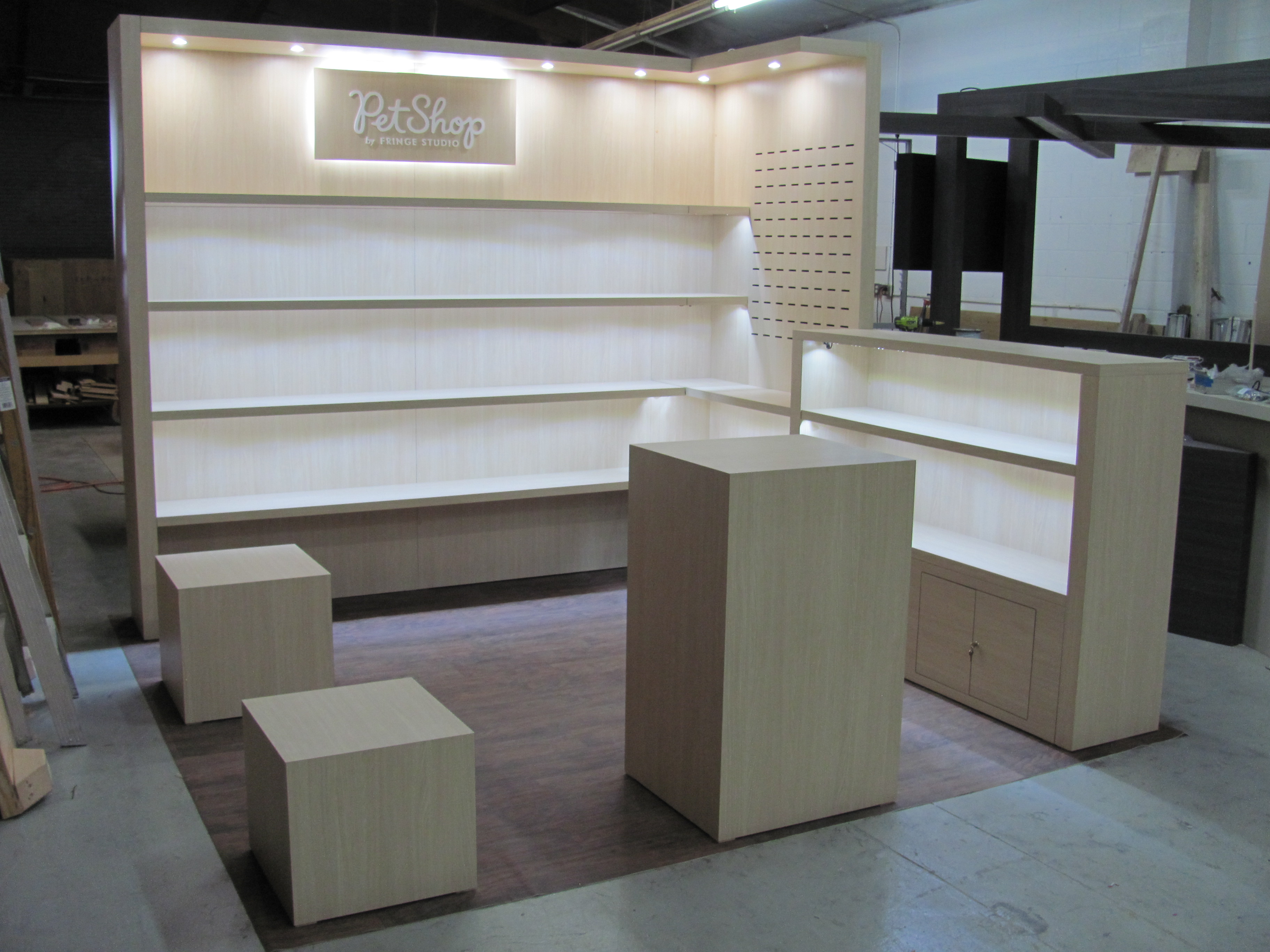
One row, several rule sets
Inline is the default booth type across Las Vegas because most exhibit halls are laid out in long straight rows, but the specific rules for what fits inside that row are not identical everywhere. The Las Vegas Convention Center's newer West Hall, Mandalay Bay Convention Center, and the Venetian Expo each publish their own exhibitor manuals, and side-wall height caps, back-wall depth limits, and hanging sign eligibility can all differ by a few feet in ways that matter to a design.
We check the specific hall's rules before finalizing any inline design rather than assuming last year's Convention Center specs still apply at this year's venue, since a booth that clears one hall's review can get flagged at another.
We keep a running reference of current specifications for the venues we work most often, the Convention Center's halls, Mandalay Bay, the Venetian Expo, and update it whenever a general service contractor issues a new exhibitor manual, rather than relying on memory from a show a year or two earlier.
Corner versus straight-run positions
A corner inline booth, at the end of a row with an aisle on two sides instead of one, usually gets a taller allowable height on its open end than a straight run buried in the middle of the row, since it has no neighbor's sightline to protect on that side. We design corner booths to use that extra height for a taller graphic panel or a small overhead element, while a mid-row straight run keeps its profile lower to stay within standard limits.
Booth position inside the hall also affects foot traffic patterns, and we factor row location, near a hall entrance, food court, or a competitor's larger island, into the layout as much as the venue's height rules.
What stays consistent across venues
Regardless of the specific hall, inline booths across Las Vegas share the same basic labor structure: material handling for anything beyond a hand-carried case runs through Teamsters Local 631, and any element that hangs from the venue's own structure, rather than sitting freestanding inside the booth, needs IATSE rigging. That baseline lets us build a design system for exhibitors doing multiple Las Vegas shows a year without redesigning the labor plan every time.
What does change from hall to hall is exactly where those lines sit, which is why we confirm the current exhibitor manual for the specific show rather than working from memory of a previous event at the same venue.
Building for repeat use
Because inline is the most common footprint, it is also the one most worth building for reuse: a well-designed inline system should adapt across the small height and depth variations between the Convention Center, Mandalay Bay, and the Venetian Expo without a full rebuild each time, at the Rio Hotel & Casino or any other hall on the circuit.
Proofing graphics before they ship
Inline graphics have the least room for on-site correction of any booth type, since a straight run rarely carries backup panels the way a larger custom build might. We proof every graphic file at full production scale and confirm venue-specific dimensions, since a panel sized for one hall's standard inline height can come up short or run long at another venue's slightly different spec.
Color proofing matters just as much as sizing, since a graphic printed by a different vendor than the one that produced a previous version can drift in color even when the file itself has not changed, and a visible shift between this year's panel and last year's booth photos is the kind of detail exhibitors notice immediately.
We also build in a short buffer between proof approval and the freight deadline, since a last-minute correction discovered after a graphic has already shipped to the Convention Center or Mandalay Bay marshaling yard has no practical way to be fixed before doors open.