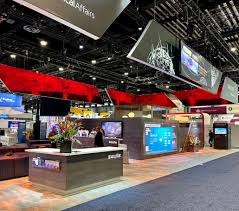
Public traffic changes the floor plan
A trade-only show can run narrower aisles because attendee counts and movement patterns are more predictable across the day. A public expo floor needs wider primary aisles and clearer sightlines to entrances, since attendance can spike sharply around a scheduled attraction or a popular exhibitor's demo, and the floor plan has to absorb that surge without creating a bottleneck.
Booth construction on a public expo floor also tends to favor open, low-barrier designs over enclosed meeting spaces, since a walk-up audience is more likely to engage with a booth they can see into from the aisle than one that reads as closed off.
Security and cash handling on the show floor
Any booth taking cash or card payments on a public expo floor typically needs to register that activity with venue security and, depending on volume, with the fire marshal's office, since cash-handling areas draw different crowd behavior than a standard demo booth. That review usually covers where cash is stored on site and how it moves off the floor at the end of each day.
Public expo floors also tend to carry a larger uniformed security presence than a trade-only show, both for crowd management around popular attractions and because public ticketed events draw a broader, less pre-vetted audience than a badge-controlled trade show.
Aisle carpet and crowd flow at expo scale
Aisle carpet color and pattern do more work on a public expo floor than on a trade-only show, since they double as informal wayfinding for an audience that has not studied a floor plan in advance the way a professional buyer usually has. High-traffic aisles often get a different carpet treatment than secondary aisles to reinforce the main circulation path.
Queueing space in front of popular booths or demo stations has to be planned into the aisle layout from the start, since an unplanned line can spill into a main aisle and slow traffic across an entire section of the floor.
Booth staffing for walk-up audiences
Staffing a public expo booth means training for shorter, higher-volume conversations than a trade-only floor typically requires, since a walk-up attendee is often making a decision in seconds rather than scheduling a follow-up call. Booth staff usually rotate more frequently on a public expo floor to keep energy up across a full day of steady traffic.
Language and accessibility needs also come up more often on a public expo floor given the broader general-admission audience, which is worth planning staffing around in advance rather than reacting to on the day.
Food, beverage, and rest areas on a public floor
A public expo floor typically needs more food and beverage service points and seating areas than a trade-only show, since general-admission attendees are spending a full day on site the way a professional buyer making scheduled appointments usually is not. Placing those rest areas away from primary aisles keeps them from becoming a bottleneck while still giving attendees a place to recover between sections of the floor.
Family-friendly programming, when part of a public expo, adds its own space and staffing requirements, from stroller parking to a designated quiet area, that a trade-only buyer show would rarely need to plan for.
Restroom and hydration station counts also need to scale with public attendance projections rather than exhibitor headcount, since a general-admission crowd spends the entire day moving through the hall rather than arriving for scheduled appointment blocks the way a trade-only buyer audience typically does.
Signage directing families and first-time attendees toward amenities tends to matter more on a public expo floor than on a trade-only floor, where a returning professional buyer already knows the hall layout from previous visits and rarely needs the same level of on-site guidance.
Coat check and bag storage near the entrance also see heavier use on a public expo floor than on a professional buyer show, since general-admission attendees are more likely to arrive carrying outerwear, shopping bags, or personal items for a full day out rather than a laptop bag between scheduled meetings.