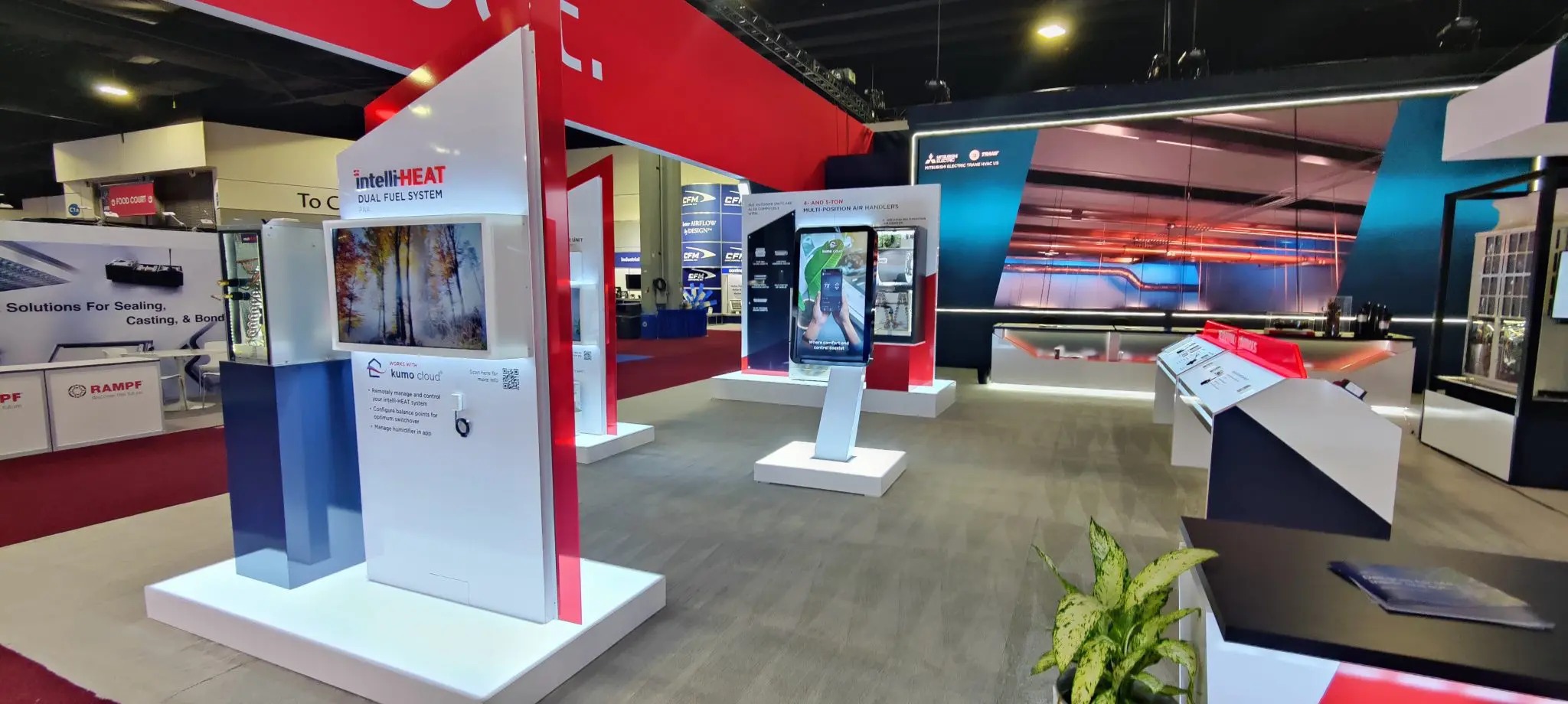
Pop-up frames versus tension fabric
A pop-up backwall uses a collapsible frame with magnetic or hook-and-loop panels that snap into place in minutes, which makes it the workhorse choice for inline booths that get rebuilt at every show. Tension fabric takes a different approach, stretching a printed sleeve over an aluminum frame for a smoother, wrinkle-free surface that reads better in photographs, which matters at venues where a booth doubles as a media backdrop.
Both pack down small enough to check as standard freight or, for smaller sizes, carry on as luggage through Harry Reid, which keeps a sales team independent of a drayage order for a straightforward inline show.
Setting up without a labor call
One of the real advantages of a pop-up or tension-fabric backwall is that a two-person exhibitor team can usually set it up without booking any outside labor, since the assembly involves no tools, no rigging, and no material handling beyond what one person can carry. That matters at meeting-focused venues like CAESARS FORUM, where a same-day setup and teardown between sessions is common and a full labor call would eat the entire turnaround window.
The exception is a backwall built into a larger custom or island booth, where it becomes part of a structure that does cross into general service contractor labor; we flag that distinction up front so an exhibitor knows which category their setup falls into.
We also confirm the specific venue's policy on exhibitor-appointed contractor labor before assuming a backwall qualifies for self-setup, since some resort properties apply stricter in-house labor rules to their meeting space than a standard Convention Center exhibit hall does.
Building a backdrop that survives a full show run
A step-and-repeat or photo backdrop takes more physical abuse over a three- or four-day show than a standard back wall, since it gets bumped, leaned on, and photographed under flash from close range. We build those on a wider base with reinforced grommets and a fabric weight that resists rippling under venue air handling, which runs stronger than most people expect inside a hall the size of Mandalay Bay's convention space.
Graphics get proofed at full print scale before production, since a wrinkle or seam that is invisible on a screen becomes obvious in every photo taken in front of it for four days straight.
We also spec a matte rather than glossy finish for most photo-moment backdrops, since a glossy surface throws camera flash back into the lens and washes out faces in the resulting photos, a detail that only becomes obvious once hundreds of guests have already used the backdrop.
Where a backwall fits into a bigger plan
Most inline booths on the Strip and at the Convention Center use a backwall as the anchor, with a counter, literature stand, or small monitor added in front of it. We treat the backwall as the one element that has to be right regardless of what else changes around it from show to show.
Production lead time before the show
A backwall's fabric or panel graphic has to be printed, finished, and proofed well before it ships to Las Vegas, since there is no on-site correction option once a show's move-in week begins. We build production schedules backward from the freight deadline a venue or general service contractor publishes, not from the show's opening date, since freight has to arrive at the marshaling yard days ahead of any exhibitor walk-in.
Rush production is possible but narrows the review window, and a backwall approved in a rush is more likely to carry a typo or a color shift that a normal proofing cycle would have caught.
We also keep a digital archive of every approved backwall file by show and by year, since exhibitors returning to the same event often want a near-identical panel with only a date or a statistic updated, and starting from the last approved file is faster and more consistent than rebuilding the design from scratch.